Showing posts with label Day 25. Show all posts

Friday, November 18, 2016

Consorts and Calendars


17112016
(Warning the spicy wings last night fucked me up...)


First full day on Seoul, headed for the Geongbukgong Palace first thing in the morning.

Well first first thing was get coffee. There are coffee shops everywhere here. They are reading add prevalent all over Seoul as the trendiest neighborhoods of New York, Paris and Vienna.

This particular shop had bagel "sandwiches" we got blue berry cream cheese, it was delicious, it was a slightly toasted bagel smothered in house made blueberr cream cheese, so really nothing to complain about.

The train is much cheaper here than Japan was, with most rides costing about 1500 won. The bus dropped us off a little ways from the palace, but provided a great view.


The palace grounds are pretty impressive, they have era appropriately dressed gate guard, that attend stoic while people take selfies with them.

We planned to arrive in time for the English language tour. And we thought we would be bumped, because there was a huge gaggle of tourists, but that was for the Japanese tour, there were alot of them throughout the palace.

The tour guide was great, had her script and mostly stuck to it, when asked a question it took her a little while to translate and then translate an answer. She was clearly very knowledgeable, the only hindrance was language barrier.

This was also our first taste of regional rivalry. See the Japanese invaded the korean peninsula in the 1590s, and then in the 1870s gunboat drplomacy-ed Korea onto a terrible treaty, and then invaded again in the1910s, and exploited the land and quite thoroughly during the WWII. The Japanese burned this place down twice. So the Koreans are rightly peeved about it.

https://en.m.wikipedia.org/wiki/Japanese_invasions_of_Korea_(1592–98)

https://en.m.wikipedia.org/wiki/Japan–Korea_Treaty_of_1876

https://en.m.wikipedia.org/wiki/Korea_under_Japanese_rule


The reconstruction efforts have been ongoing since 1990, the present palace has been built up to about 15% of its former glory, and of that about 60% was surviving structures that just needed rehab.

It was built by the first of Joseon dynasty in the 1390s, who took over after defeating the previous dynasty. Like most palaces it was added to over time.

The big outer courtyard serves to impress guests, and provide security, back in the day there would have been stuff here, but now there are just some trees.


The inner courtyard has the throne room. This is where the king recieved official guests and conducted state matters and various ceremonies.

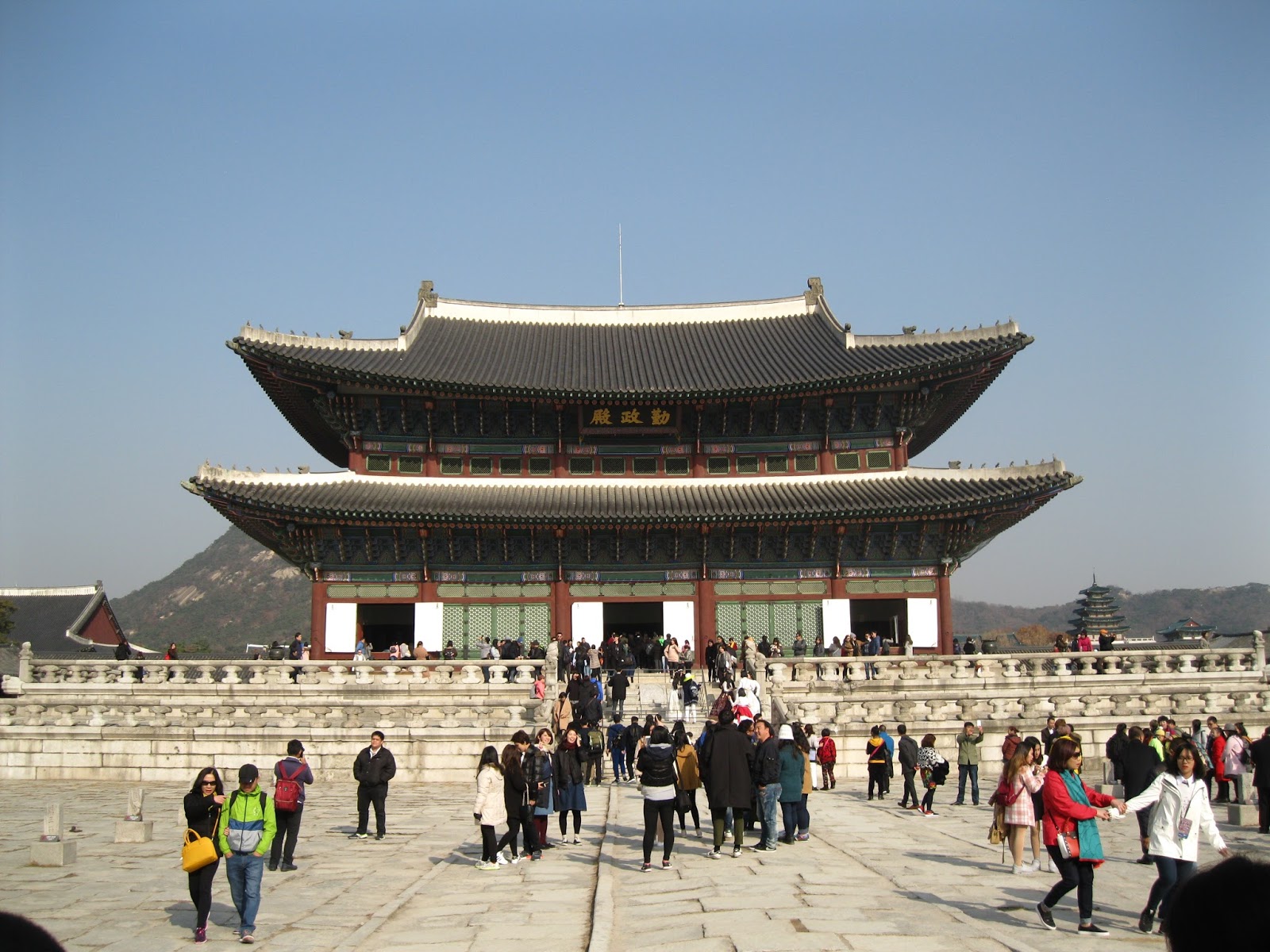

Behind that were the actual chambers for the king, and queen. Which were seperated. The king had maid-nurses to look after him and a half dozen concubines. The queen managed the palace affairs. They met once a month to attempt to create an heir, at the best time of the month according to the stars and moon. Meaning thy had astronomers and calendaronomers encouraging them to bang. If the queen didn't conceive, she would adopt one of the sons from the concubines and everyone pretended it was legitimate.

You might notice on these houses there is a sort of pit or door on the side that seemingly goes into a basement. This is actually a fire pit for the heating system. They would build fires here, and the smoke would run under the stone floor to the chimney, heating the room from the floor up. This also explains why Koreans sit on the ground, and have no furniture.

There was a great banquet area. Because you can't be a King without throwing gutwrenchingly ostentatious parties. It even is surrounded by a pond for boating, or when the Chinese envoy drinks too much rice wine and needs a quick dunk to sober up.


The palace grounds is also home to the first (according to the slightly biased your guide) use of grid-level electricity in East Asia. One of the forward looking crown princes installed electricity, in what today is the president's house.

We witnessed the changing of the guard ceremony.


I don't speak Korean, I wasn't in a XV century army. But I recognized the commands given by the captain of the guard, with a 10 minute warm up, I could have been one of these guys in costume (except for my green eyes, lack of wispy black beard and Brown hair). It's interesting how a XVIII century Prussian based drill and ceremony manual differs only in language from something born 5000 miles away and 300 years earlier.

After this we went the museum of all the relics and stuff that would have been IN the palace if it were in use. I made use of their toilets in a catastrophic way. The museum was free, it was a great museum, all the better due to the sans cover charge.

Here we learned about the day to day lives the king and queen and princes and courtesans and administrators.

The most interesting thing was the fastidious recording of everything. All the state goings-on were recorded, any official metric the king had, had court stenographers noting everything. These notes were kept up until today, the interesting part was the confidentiality of it, as long as the king was seated, these records were sealed, even to himself. And crown princes were strongly encouraged to read the chronicles of previous Kings, to learn the ropes before actually handling the fate of the nation.

Also administrators and beaureaucrats had to pass an exam before recieving the title and position they sought.

We intended to go to a dumpling place, but I was given the wrong address so we walked into a traditional neighborhood on a hill. With old timey though still occupied houses, very much like Kyoto, with very traditional Korean homes. Unfortunately, I was desperately looking for another toilet to desecrate, so after discovering this was the wrong address, we found a coffeeshop, with a toilet for me to defile. Fortunately upstairs from the cafe was a probiotics shop making smoothies with kimchi biotics, helped my tummy calm down.

We reassessed, and got ourselves to the dumpling place. Had a variety poster of steamed and fried pork dumplings of various varieties.

This shop was next to a craft mall, a multi storey open air Mall with handmade and probably-fell-off-the-truck stuff. We got some gifts for family and friends.

After this we went home to research dinner. We decided on bi bim bop, find a famous place. Went to it, and was underwhelmed. There was a stove bowl bibimbap a regular bubimbap bowl, and a soup. It was ok, wasnt bad, and it was alot of food for cheap. But given the supposed reputation of this place, we were expecting more.

After this we wandered into the Sinchon/Dongdaenun neighborhoods. This is the college area, there are at least 3 universities here, so the barscene is pretty great. We found a place with inexpensive beers, laura got some craft beer and I got the "house beer" which is akin to a black and tan. It's Beck's (who knew they had that over here) with Asahi Black floated on top.

After beers, we went home to bed.

Saturday, August 4, 2012

Graduation day!


30712

soo we are done with class, so no more boring posts about class. we had about an hour of hanging out in class, talking to Jonatan (who i have since friended on Facebook) then we had to give our presenation on the conflict, which went awesome by the way. the presentation immediately before us was about wine, so we all got samples, and luckily there were a few left over at the end, so me and mike had a few extra styrofoam cups of wine to calm the nerves before/during the presentation. we rocked it, i did my normal make it up as i go talky-talk bit, Claudia seemed satisfied that i wasnt reading off the slides (though it was ok for mike to do so) and still manage to be articulate with my spanish. again this whole class situation reminds me very much of middleschool, it is about the same level of spanish on my part, and then the presentation and lectures were about the same as that (similar topics as well)

after this was the fantastic graduation ceremony, we were handed our "diplomas" and grades, i did ok? im still not sure how that rubric worked, but i got like a B maybe? then we got to eat food, various types of empenadas (including a cheese and fig empenada that was not very good), luncheon meats, including liverwurst, or whatever it is called here, i spread that on some buns, and ate prolly half of the liverwurst while elliot (the other undergrad-graduee) ate the other half.

we headed to a bar to watch more Olympics, much of the group went to a pirate bar accross the street from the irish bar our friends got their shit stolen from. i and a few others however, went to the irish bar, which was cool, cause it was pretty much the 5 of us, and the bar owner who let us watch whichever channel we wanted of the Olympics. we ent up watching field hockey, and basketball highlights.

mike and i made it home for dinner and chatted with our homestay guy and his girlfriend, and went out to a bar we had tried to get into earlier on the trip but had a group that was too large. 6 of us made our way over there, and went upstairs to sit down, running into a group of 3 girls from our trip in the process. they were dirnking delicious raspberry mojitos, and having a grand ole time, i managed to steal a bunch of peanuts from them, as the waiter was taking forever to get to us. we had a beers and good laughs and an absurd amount of shelled peanuts.

we went home relatively early to prepare for our trek to Patagonia

Friday, June 1, 2012

ranty


31512 after our morning class we had a tour hosted by a survivor of the work camp we were scheduled to visit, František Zahrádka (from now on, this man will be refered to as "he" a he was telling us stories). first we stopped in Příbram, a small town which housed the museum to the Third Czechoslovak resistance. the First being, the free czech legions fighting the Hapsburgs, via the Italian and French Armies, the Second fought the Nazis, and the Third resistance, were the communist resistance movement, only officially recognized in 2011 though the small museum we walked through dates back to 92. He worked with the resistance smuggling the czech RAF pilots out of the country to help them avoid the persecution by the new communist regime, cause you know, obvioulsy if they worked with the RAF (training Israeli pilots they were against the commies). He worked closely with american agents in Germany to achieve this. Real fear of WWIII breaking out as communism rolls through eastern europe, the situation in berlin particularly. Because of this many of the dissidents and resistance members, did not care for the length of sentence, they figured the war would start and they would be freed eventually by the victorious West anyways. He was 19 when he was shipped to the labor camp, where he was sentenced to 20 years of his life. The only reason he didnt recieve the death penalty was because the year before the government passed a law forbidding the execution of any under age of 20. He ultimately only spent 13 yrs in the camps. After his sentence was served, with his parents dead, he had no where to go, so he signed on with the uranium mining outfit which he worked for as a prisoner, as a qualified electrician. He worked till retirement at this mine.
While there were many who actively resisted, and were "punished", there were people who didnt cooperate with the communists, who were punished in the same fashion so the inmates in the forced labor camps were very different. The Germans actually did the original surveying noting there was uranium here. The Soviets were desperate to get the uranium to develop their one nuke program, and they subsequently pushed the czech communisnts to get the land. The Nazis had plans to reclaim the uranium, and started lying down the infrastructure necessary, but never got around to it as the war ended. In 1947 the russians brought in German POWs to do the work. By 1949, the German POWs were returned to Germany, and the labor was replaced with Czech subversives. Random facts about the camp: These mines produced very rich uranium veins, but the area also had silver and lead deposits. Some of the shafts went down to 1800m. Housed 1800-2000 inmates. it is a little disjointed, these were notes i took as he spoke to us (via a Charles University history professor translation), being a cool old guy, his stories and information came out a little haphazard, id prefer to keep it as is. He really wanted to note that there were good people, guards and civilian workers that did small things to make life easier, a scrap of food here, or a letter smuggled there, and from this pool of good people, there were those that went beyond and helped inmates to escape as well. this camp was very different from the Nazi labor camps, i didnt feel that collective guilt that was imposed in the facility yesterday, this guy lived through this, for a number of years, and he told us stories of his friends being shot before his eyes, or being beaten to within an inch of his life. but he seems to have come to terms with it, the Communist system which abused him and his people so, is over and done, and while i will never forget, he doesnt strive to remember. i know that sounds weird, but i feel like he isnt dwelling on the tragedies of the past, its something he acknowledges, and conveys to us (future generations) as bad, but he believes that like he did, we will do what we can to prevent anything like that from happening again. whereas in the Holocaust memorial stuff, i feel like i am just being emotionally berated, i mean, both of my grandparents were members of the US military through WWII, they actively endeavored against the Nazis in some way or another, i have no genealogical connection to the Holocaust (victim or victimizer) but i end up walking away from these places often times feeling guilty. and i chalk that up to the memorial/museum not being done well, i have mentioned a few that were well done, and i notice now that it is because i walk away sobered certainly, but also learned, not just feeling shitty. this kinda came up in class as well, we talked about Lidice and the concentration camp visits, and people mentioned how powerful it was to see that, and i brought up the point that the Lidice was a really good example for us, Lidice wasnt just the Nazis killing Jews (again not to lessen the tragedy of the systematic destruction of an entire people), it was a reprisal against the Czech people. WWII specifically, but accross history, there are countless accounts of tragedy visited upon a people for some reason (be it "legitimate" or not). i feel like we get caught up on the Holocaust alot, but then forget the historical genocide of the Irish, Native Americans, Albanians, and the Muhajir to name a few. basically, im sayin the world is a shitty place, memorials are good, but they most come with at least objectivity, and hopefully forgiveness.

Wednesday, July 27, 2011

Wednesday 27711

we are now in Mostar, very cool old city, the hotel is nice, though my IP issues have struck again, and i am unable to get onto the internet on my own computer, so this will be a little brief, and lack pictures, as soon as i get to good internetz, ill upload pictures.

[edit pictures like this]


we left Sarajevo early afternoon, after waking up a lil later, we did get to go to this awesome (read atrocious) museum. it was on the intersection where the whole assassination of Franz Ferdinand took place, the museum was one room, had a handful of rifles and a postmans uniform, and a parlimentarians uniform, and some random hats and knickknacks from the time period.

the busride was uneventful, Mostar is cool, the bridge that was rebuilt is cool, its a shame it was annihilated during the war, the bridge would be alot more impressive if it were 500+ years old.
http://en.wikipedia.org/wiki/Mostar

the paper is still looming over me, i gotta finish it up, wish me good internet in future hotels so i can make this more interesting for everyone.